Thursday, March 17, 2011
The color of my hijab.


Tuesday, April 7, 2009
HOW TO MAKE A SILHOUETTE
Most Muslims do not have pictures of their loved ones around their home or office. This is because of the ban on images of people and animals. We do have them but hidden away in albums, photo boxes and stored digitally.
Silhouettes are a great way to have a little reminder of our loved ones and they are easy to make.
MATERIALS
- Digital camera
- Computer
- Paper of different colors, prints and textures
- Drawing implements (pencils, rulers, erasers etc.)
- Scissors
- Little decorate collections of bits and pieces ( ribbons, buttons, rocks, shells etc)
- Picture frame
METHOD
- Select a theme. You can choose one them for your entire family or individual for each person. Play around with ideas before you start.
- Take a picture of the person's profile using your digital camera.

3. The load into your computer and print using Microsoft Office Picture Manager and WORD and resizing to a size that you would like. You do not need to print in full color. I used the draft preference.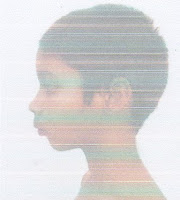
4. Use a pencil or marker to draw an outline around the image. 
6. Cut out with a scissors and place on a piece of a paper which you have chosen for your silhouette. Trace out the template and cut out.
7.Now you are ready to decorate and design to your heart's desire. When your picture is finished place in a frame and hang in a chosen spot on your wall.

Have fun and be a s creative as you like!
Wednesday, January 23, 2008

Friday, January 18, 2008
One Point Perspective
One Point Perspective is when one vanishing point is used.

Step One: Draw a line border around your page/paper.
 Step Two: Draw a horizontal line (blue line)across the top part of your paper.

Step Four: Draw a square in the lower left hand side of your paper.
 Step Five: Draw lines (green lines)to the three corners of the square. These are construction lines.
 Step Six: Draw parallel lines (orange lines) to make two sides of the cube. now you should be able to see a cube. If your lines are not parallel the shape will be distorted.
 Step Seven: Now you can add color. It is important to use color in three values or shades. The square will have the darkest color because it is the closest to you. In perspective, the object or the part of the object that is the closet to you is the darkest color. Next the top will be the lightest because it is the most exposed part. and the remaining will be the middle shades.
 Step Eight: To make the cube really look 3D you will have to add a shadow. In this case you can see that light is coming from the vanishing point so you will be adding the shadow from that point. Draw the shadow lines. (grey lines) Notice that one shadow line continues from one green line or one side of the cube and the other actually passes through the other corner/ angle of the cube.
Step Nine: fill in the shadow area with a medium shade of grey.
 Step Ten: Erase or delete all construction lines except for the horizontal line. Attend to details and make sure all your lines are straight and colors are well placed.
 Step Eleven: Put in your background color which would be light and your foreground color which would be dark.
 Monday, January 14, 2008
Art brings Muslim, Jewish students together
They complied artworks for an exhibition “Coexistence Through Art" held on Nov. 27 at the Addison-Penzak Jewish Community Center, 14855 Oka Road in Los Gatos.
They are trying to get out the message of coexistence. They feel that it is the future and that we can work things out in the Middle East if we can respect each other.
It is a wonderful endeavor and commendable indeed.
Tuesday, January 8, 2008
Al-Aqsa Masjid

Many may think that Art education is a waste of time in Islamic schools. However art education does not only teach creativity and inventiveness but also culture, history and general knowledge.
After all can you tell which of the two pictures above shows the Al-Aqsa Masjid?
Which did you choose? The one on the right is not and is actually thought to be the Al-Aqsa Masjid by a lot of Muslims while the actual Masjid is shown on the left. The one on the right is actually the Qubat As-Sakhra Masjid.
Knowledge is power and depriving our children of any type can be more devastating that you think.

Monday, January 7, 2008
Islamic school of Art

Muslims follow Madhhab; these are Islamic school of thought or (figh) religious jurisprudence. There are four; the Hanafi, the Maliki, the Shafi’i and the Hanbali.
In the art world there are also schools of art according to style or a movement as belonging a particular group of artists. These artists have a common influence or origin. It is not a physical school but reflects the style of art around that time.
Islamic art is not easily recognizable because Muslims vary from nation to nation except if it is traditional in nature; e.g. Arabic calligraphy or the architecture of a Masjid.
But the one feature which would indeed unify Muslim artists would be the belief that to draw realistic images of people and animals are forbidden. Also not only to create these images but also the way that they are used. Still with the vast array of media and medium it would be difficult for all contemporary Islamic art to look the same. My guess is that it would also reflect the culture of the artist, his style, the medium he uses, the influences which are endless and so much more.
It would be extremely interesting to see what an actual Islamic Art School would be like. Well there's a link to a traditional school .
http://www.psta.org.uk/index.php?n=Main.Homepage
This one in Pakistan seems more secular than Islamic.
http://www.nca.edu.pk/index.htm
Friday, January 4, 2008
Islamic Art teaches Math

Many Islamic artistic expressions were done in intricate patterns and exquisite geometric designs. Math is the tool that is used to create such beautiful eyefuls.Today many are using this most famous aspect of Islamic art to teach algebra, geometry and calculus of Math in classrooms and colleges. It provides an exciting medium to an otherwise “boring” topic. Radial, symmetry and tessellation can provide an easy way for students to learn about these concepts in Math.
You can check out this book;Geometric Concepts in Islamic Art (Paperback)by Issam El-Said (Author), Ayse Parman (Author)
Links to check out how it is done.1. http://www.collegenews.org/x4595.xml2. http://homeschoolmath.blogspot.com/2007/02/geometric-patterns-in-islamic-art.html3. http://www.mtholyoke.edu/offices/comm/news/summermath.shtml4. http://www.artteacherconnection.com/pages/anrtandmath.htm5. http://mtcs.truman.edu/~thammond/history/Art.html6. http://www.vam.ac.uk/school_stdnts/schools_teach/teachers_resources/maths/index.html
Thursday, January 3, 2008
Prayer Mats
 Images can be very influential and no where is that more obvious than when I am praying. First I make sure that my environment is clean, I make wudu, check my clothes to see if they are clean and cover me well. Then I lay down my prayer mat and pray. Easy right?
Well sometimes concentrating can be hard and ever so often my mind wonders, especially if my kids are around. But even before I had kids, work and a job there was something that bothered me some what. You see, when I am looking down and trying to think about my Lord, the prayer mat stares back at me! And it might not be a pretty face I see.
Am I nuts? Mats with eyes? Well…at first I felt a bit funny. Growing up we prayed on a large soft brown carpet with no designs. But as I got older and would sometimes pray by myself I would use the prayer mats made for one person. These mats have a lot of designs. The designs do not have realistic images of people or animals. In fact the designs are mostly of Islamic themes and pictures. These pictures might have the Kaaba or a holy place.
The thing is that when one stares long enough at these mats one can actually see faces. These “faces” usually make “ugly looks” and would sometimes make me jump. But now I don’t have that problem. I have found that it used to bother me. Alhamduillah now I just have to concentrate on my prayer and not the imaginative "creatures" staring at me. I see enough of that when I look in the mirror.
Wednesday, January 2, 2008
AerosolArabic

http://www.aerosolarabic.com/v2/index.php
He has been creating murals in the Us but he is from England and is working hard there and Europe to promote Arabic calligraphy through an unlikely media; graffiti. A sure way to touch the man in the street. I wish that my students would be able to interact with him. They would be so motived like I am.
Tuesday, January 1, 2008
Zarah Hussain

Zarah Hussain is from Pakistan. She paints simple yet elaborate works of art using simple geometric shapes to form intricate designs and patterns. She is exhibiting her work at the Walthamstow gallery until the end of this month, January, 2008.
As I don’t live in London I cannot view her art in exhibit. But never the less I can enjoy her work from a “distance”.
From her websitehttp://www.zarahhussain.co.uk/ I can tell that she embodies her belief in her art and certainly can be an example for many to follow. I really am impressed with her designs and inspired by her talent.
Drawing the Kaaba

Step one - Draw a line across the bottom half of your paper. This your horizon line. It separates the foreground from the background.
Step Two - Draw a square making sure that most of the shape is above the horizon line.  Step Three -Draw another square behind square number one, making sure that it finished below the horizon line and a little to the side.
 Step four - Now join the two squares by drawing straight lines (red lines) from the four corners.
 Step Five -Draw four more straight lines (red lines). Two on the square number one and two on the side facing you in a slight angle.
 Step six - To add the background, start by adding two horizontal lines (green lines) and drawing the tower.
 Step seven - Next to draw the arches, draw some vertical lines (green lines).
 Step eight - To complete the arches draw some slightly curved lines ( blue lines)
 Step nine -You are ready to color. Color square number one with black leaving the space between the two red lines blank. Color the top space in a light brown or any other light color. Color the side in a medium grey. Color the band around the Kaaba in yellow.
Sunday, December 30, 2007
How to draw the head of a girl wearing Hijab.

erase without a mess. Draw an oval. This is the skull.

Step two – Draw another oval. This will be the face.  Step three – Add the shape of a cylinder to form the neck.
Step four - Draw a line (red line) where the two ovals divide each other. This is where the eyes will be.
 tep five – Draw another line (red line) below the first. This is where the nose will be.
Step six – Draw another line (red line) below. This will be where the mouth will be.
 Step seven – Draw the face (green line) using the red lines to guide you.
Step eight – Next, draw a line (green lines)to form the neck line
and the Hijab at the back of the head.

Step nine – Now draw a line (green lines)to join up and make the bottom of the Hijab.

Step ten – To finish forming the Hijab, draw lines (blue lines) from the top of the head to the neck and across the forehead. Erase any lines which might protrude out of the face or else where.

Step eleven – Color in the face using a color you like.

Steps twelve – Color fill the forehead part of the Hijab with another color that you chose.
 Step thirteen – Color in the shawl.
Step fourteen – Add any decorative designs you would like.
 Step fifteen – Add a background.
Now you have completed a silhouette of a Muslima!
Experiment with designs and colors to make some very interesting pictures.Alhamduillah! After some practise you should be able to draw a head without all the construction steps.
Friday, December 28, 2007
The Muslim Artist at Work
Many may say that they cannot draw and is afraid of their work being laughed at or dismissed as frivolous. For the Muslim artist, there is comfort in the knowledge and belief that God is perfect and He alone can create in perfection. Therefore we must not be afraid of the end result of our work because it is the process which is the most important part of the experience.
Since Muslims recognised that God has all the responsibility of being perfect, we would do our very best and accept what we did. We are merely "photocopiers" of all that is around us. Mind you we must do our best and not make something with a haphazard attitude. A person's first reaction to seeing our work is honest and should be taken as constructive criticism. That is; whatever the comments we hear be should be able to build our resolve to do better or improve in anyway we can. Or we can simply ignore the negatives; in fact we must and remember that it is the process that is more important than the end result.
The creative process is the reason, in the first place, why we are artists. The sensual feeling of the paint brush, the soothing colors, the passion of drawing, the joy of building and the satisfaction we get from involving in our selves in something so enjoyable that we do it even if there is no monetary benefit from it.
It is especially important for adults to remember this when asked by a child if they like their work.
Scenario - Fatima is happy. She just finished her drawing for the story she wrote yesterday. She loved the rabbit she drew and the colors she used. She shows it to her teacher. What do you think the teacher's reaction should be?
Some may laugh or begin to point out all the "mistakes" Fatima made. but remember that it was the process through which Fatima learnt not the end result. She learnt from using colors and developing her brain creatively.Our students should not copy a template which we made for them nor should they be told what to do on the exact details of their work. They must be able to use their imagination and inventiveness as this is the objective of art in our classrooms; to build a brain that is creative and innovative.
For the adult artist, this creative process is equally important, more so because much more planning is involved. We plan our compositions, make sketches, practise and practise until we have something we like to develop or work on. Not all of our pieces will be a masterpiece but that is okay because the Master of masterpieces is not going to laugh at our work.
Distractions
And the people of Moses made in his absence, out of their ornaments, the image of a calf (for worship). It had a sound (as if it was mooing). Did they not see that it could neither speak to them nor guide them to the way? They took it for worship and they were Zalimun (wrong-doers).
Commitment to other things in our lives can distract us from the real emotions and feelings. This can come about from putting our trust in things other than God. Humans crave companionship and affection to fulfill the meanings in our life. We will love people, pets and have attachments to various things. Some people would have their pets pictures around them, look and collect pictures of a famous person etc.
But the problem starts when these things become a distraction for us and we forget God and fulfill the voids in our life not with prayer but with things that cannot help us in any way. God is the only one who can help us in ALL aspects of life. He is the one who can make sure that the things and people we love are taken care of. What can be really dangerous is when we are so engrossed in connecting with these sometimes superficial relationships and spend so much time, effort and money behind these pursuits that we forget to connect with our Creator and Sustainer.
People, in their quest to keep a hold on things from the past, would keep pictures of their pets and people they love and slowly begin to do things that have no meaning. Like looking at the picture and talking to it. They may place flowers next to the pictures or do something which helps them to deal with the lost of a loved one.
It is extremely difficult to deal with the lost of someone. Knowing that they are in a better place would be able to help.
We can help people who have past on by praying for them and talking to God about our feelings about them. One can not forget a loved one but we can find solace in prayer and du’ah. We can talk as long as we like with God, its free and we don't have to make an appointment.
Thursday, December 27, 2007
The Image of God
He is one; this means that there is no other like him. And we have never seen Him. He would not therefore plaster His image everywhere like on toast or a tree because it would become mundane and part of his creations. He is a Creator not a creation. He created Himself.
The Noble Qur'an - Al-Anbiyâ 21:51-54
51. And indeed We bestowed aforetime on Ibrâhim (Abraham) his (portion of) guidance, and We were Well-Acquainted with him (as to his Belief in the Oneness of Allâh, etc.).
52. When he said to his father and his people: "What are these images, to which you are devoted?"
53. They said:"We found our fathers worshipping them."
54. He said: "Indeed you and your fathers have been in manifest error."
· His image is then not like the mortal man or any other thing. And as such cannot be imagined by any mortal artist. His image is much more than we can imagine. That is because His powers cannot be imagine by our limited mind. His image cannot be rendered by our limited skills.
· His image is too great for our average eye to see when we cannot even see beyond our horizon. The eye of the human is not powerful even as some animals that have more sight than us. Our limitations as mere humans prevent us from seeing God’s great image.
· If God is pictured as something as low as men then we are to assumed that He will have powers only as a man. But His sight is not like us, only much more powerful, His hearing is not like us, only much more powerful, everything about Him is much more powerful any man would ever have.
· People have claimed to be spoken to by God or to have had a vision of Him. Satan can come to a person claiming to be such or such. He is the ultimate con artist and this is precisely why we don’t have an image of God. Because Satan would come to people using what they want to see as God and tell them to follow him; a false god. He can come to us using what we desperately wants to see and experience and for the vulnerable it can become a trap taking us away from the One True God. Jesus himself was tried in this way when Satan came to him in the desert to try leading him away from his beliefs.
· As we have seen in Christianity the “image” of Jesus is worshipped and his mother too. God has sent prophets to all people and when these prophets die, in their grief people make images of them and worship them. Also they might have seen them and wanted to have something to remember them by so they make images of them or there may be a thousand other reasons why people made images of their holy people. However these trends tend to lead people away from the One True God. What good is an intercessor when a person can pray straight to God? People do not need idols or images to pray to God. All that is required to have a sincere intention and to pray from the heart. God understands all language and with His most great and powerful hearing He can hear all zillions of us anytime, anywhere, anyhow.
· And to be politically correct what would He actually look like if his image was rendered as a man? A white man or a black man? A Chinese man or a Hispanic man? Who would be offended? Even women would begin to object; thinking why God has to be a man. Because He is not a man nor a woman nor any of His creations. He is one, unique, original and not represent able. And it is therefore not possible to make images of God.
My work