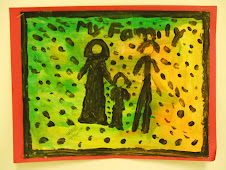
Three schools; Silicon Valley Academy (Muslim), and Yavneh Day School and the Congregation Shir Hadash (both Jewish) all in California got together to try to bring together two communities; Jews and Muslims.
They complied artworks for an exhibition “Coexistence Through Art" held on Nov. 27 at the Addison-Penzak Jewish Community Center, 14855 Oka Road in Los Gatos.
They are trying to get out the message of coexistence. They feel that it is the future and that we can work things out in the Middle East if we can respect each other.
It is a wonderful endeavor and commendable indeed.
Monday, January 14, 2008


Tuesday, January 8, 2008
Al-Aqsa Masjid

Art History
Many may think that Art education is a waste of time in Islamic schools. However art education does not only teach creativity and inventiveness but also culture, history and general knowledge.
After all can you tell which of the two pictures above shows the Al-Aqsa Masjid?
Which did you choose? The one on the right is not and is actually thought to be the Al-Aqsa Masjid by a lot of Muslims while the actual Masjid is shown on the left. The one on the right is actually the Qubat As-Sakhra Masjid.
Knowledge is power and depriving our children of any type can be more devastating that you think.
Many may think that Art education is a waste of time in Islamic schools. However art education does not only teach creativity and inventiveness but also culture, history and general knowledge.
After all can you tell which of the two pictures above shows the Al-Aqsa Masjid?
Which did you choose? The one on the right is not and is actually thought to be the Al-Aqsa Masjid by a lot of Muslims while the actual Masjid is shown on the left. The one on the right is actually the Qubat As-Sakhra Masjid.
Knowledge is power and depriving our children of any type can be more devastating that you think.

Monday, January 7, 2008
Islamic school of Art

Muslims follow Madhhab; these are Islamic school of thought or (figh) religious jurisprudence. There are four; the Hanafi, the Maliki, the Shafi’i and the Hanbali.
In the art world there are also schools of art according to style or a movement as belonging a particular group of artists. These artists have a common influence or origin. It is not a physical school but reflects the style of art around that time.
Islamic art is not easily recognizable because Muslims vary from nation to nation except if it is traditional in nature; e.g. Arabic calligraphy or the architecture of a Masjid.
But the one feature which would indeed unify Muslim artists would be the belief that to draw realistic images of people and animals are forbidden. Also not only to create these images but also the way that they are used. Still with the vast array of media and medium it would be difficult for all contemporary Islamic art to look the same. My guess is that it would also reflect the culture of the artist, his style, the medium he uses, the influences which are endless and so much more.
It would be extremely interesting to see what an actual Islamic Art School would be like. Well there's a link to a traditional school .
http://www.psta.org.uk/index.php?n=Main.Homepage
This one in Pakistan seems more secular than Islamic.
http://www.nca.edu.pk/index.htm
Subscribe to:
Posts (Atom)